
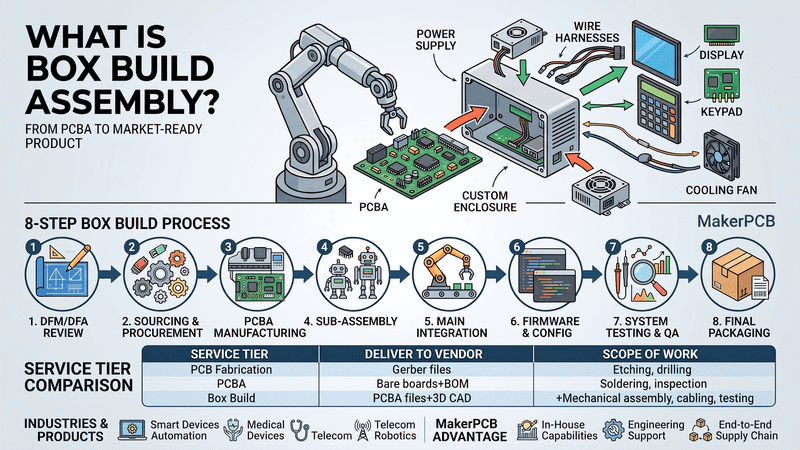
Box build assembly (also known as electromechanical assembly or systems integration) is the manufacturing process of integrating populated printed circuit board assemblies (PCBAs), wire harnesses, power supplies, custom enclosures, and displays into a fully functional, packaged, and tested electronic product.
While standard PCB assembly (PCBA) provides a populated board, box build takes the project to completion—delivering an out-of-the-box, ready-to-ship device directly to end users or distributors.
This guide explains how box build assembly works, compares it to PCBA and turnkey manufacturing, outlines the step-by-step assembly process, and details the documentation needed to get started.
What Does Box Build Assembly Include?
The term "box" refers to the product's outer housing or enclosure (plastic, sheet metal, extruded aluminum, or die-cast). "Building the box" covers the mechanical and electrical integration required to assemble a complete unit.
Depending on the complexity of your device, a box build manufacturing scope can include:
• PCB Fabrication & SMT Assembly: Populating surface-mount and through-hole circuit boards.
• Cable & Wire Harness Integration: Custom crimping, routing, and termination of internal interconnects.
• Enclosure Sourcing & Fabrication: CNC machining, plastic injection molding, sheet metal stamping, and surface finishing (anodizing, powder coating, painting).
• Electromechanical Assembly: Installing displays, keypads, cooling fans, connectors, sensors, and battery packs.
• Potting & Conformal Coating: Environmental sealing for moisture, dust, and vibration resistance.
• Firmware Flashing & Calibration: Loading software images, configuring boot parameters, and serializing.
• System-Level Functional Testing: Verifying electrical safety, RF connectivity, I/O performance, and thermal management.
• Custom Retail Packaging & Kitting: Barcoding, user manuals, accessories, and drop-shipping.
Box Build vs. PCBA vs. Turnkey Manufacturing: Key Differences
Understanding the distinction between manufacturing tiers helps you select the right level of service for your product lifecycle.
| Service Tier | What You Deliver to Vendor | What You Receive | Scope of Work |
| PCB Fabrication | Gerber / ODB++ files | Bare circuit boards | Etching, drilling, plating, solder mask, silkscreen |
| PCB Assembly (PCBA) | Bare boards + Components (or BOM) | Populated, board-tested PCBAs | SMT, THT soldering, AOI, X-ray, In-Circuit Testing (ICT) |
| Box Build Assembly | PCBA files + 3D CAD + Assembly Drawings | Fully integrated device in enclosure | PCBA + mechanical housing + cabling + firmware + system FCT |
| Full Turnkey Manufacturing | Product specifications / Design files | Packaged, retail-ready product | Complete parts procurement + PCB/Enclosure fabrication + Box Build + Global logistics |
Why PCBA testing alone is not enough: A circuit board can pass 100% of board-level automated optical inspection (AOI) and in-circuit tests, but still fail inside its enclosure due to thermal throttling, ground loops, pinched cable harnesses, or electromagnetic interference (EMI). Box build testing validates the entire system in real-world operating conditions.
Which Industries and Products Rely on Box Build?
Box build assembly is the standard manufacturing route for commercial and industrial electronics across diverse markets:
• IoT & Smart Devices: Edge gateways, environmental monitors, smart home hubs.
• Industrial Automation: DIN-rail controllers, PLC modules, HMI touchscreens, motor drives.
• Medical & Diagnostic Devices: Patient monitors, handheld test analyzers, laboratory instruments.
• Telecommunications: Network switches, wireless access points, base station routers.
• Robotics & Automotive: Autonomous mobile robot (AMR) control units, vehicle telematics boxes.
• Energy & Power Electronics: Inverters, battery management systems (BMS), solar controllers.
The 8-Step Box Build Manufacturing Process
A professional Contract Manufacturer (CM) follows a structured, repeatable workflow to ensure consistency from prototype batches to mass production:
1. DFM and DFA Engineering Review
Engineers evaluate the 3D CAD models, Bill of Materials (BOM), and schematics. Design for Manufacturability (DFM) and Design for Assembly (DFA) reviews identify tight tolerances, assembly bottlenecks, or thermal conflicts before cutting tooling.
2. Component Sourcing & Incoming Quality Control (IQC)
Active/passive electronics, custom metal or plastic enclosures, silicone gaskets, fasteners, and custom cables are procured. All incoming lots undergo IQC inspection against engineering drawings.
3. PCB Fabrication & Assembly
Boards are fabricated, populated via high-speed SMT lines, wave/selective soldered, and inspected using 3D AOI and X-ray inspection.
4. Sub-Assembly Preparation
Custom cable looms and wire harnesses are cut, stripped, crimped, and pre-tested. Sub-modules (such as power supplies, displays, or cooling heatsinks) are prepared for swift integration.
5. Final Mechanical & Electrical Integration
Technicians install PCBAs into the custom enclosure, route internal wiring with proper strain relief, apply thermal interface materials (TIM), and torque fasteners to precise specifications.
6. Firmware Flashing & Configuration
The device is connected to programming fixtures to flash bootloaders, application firmware, MAC addresses, encryption keys, and calibration constants.
7. End-of-Line Functional Testing (FCT) & Quality Assurance
The completed unit undergoes full validation:
• Functional Testing (FCT): Verifying all physical ports, wireless links (Wi-Fi, Bluetooth, 4G/5G), buttons, and displays.
• Safety & Compliance Testing: Hi-Pot (high potential dielectric withstand), ground bond testing, and insulation resistance.
• Burn-in & Environmental Stress Screening (ESS): Thermal chamber cycling to weed out early-life component failures.
8. Custom Packaging, Serialization & Drop-Shipping
Finished units receive custom serial numbers, regulatory labels (CE, FCC, RoHS), and are packed in custom foam inserts or retail packaging ready for worldwide distribution.
What Documents Do You Need for a Box Build Quote?
To receive an accurate, fast-turn box build quotation, prepare the following engineering package:
1. Bill of Materials (BOM): Comprehensive list including PCB components, mechanical fasteners, cables, enclosures, labels, and packaging materials with manufacturer part numbers (MPNs).
2. 3D CAD Files & 2D Mechanical Drawings: STEP or IGES files of the complete assembly, showing tolerances, critical dimensions, and material finishes.
3. Schematics & Gerber / ODB++ Files: Complete board layout files for the internal PCBAs.
4. Wiring Diagrams & Wire Run Lists: Detailed pinout diagrams, wire gauges, color codes, and connector part numbers.
5. Assembly Instructions / SOP: Step-by-step guidance on assembly sequence, torque values, adhesive applications, and cable routing paths.
6. Test Plan & Acceptance Criteria: Specific pass/fail limits, test procedures, diagnostic software requirements, and calibration instructions.
Why Choose a Single-Source Partner for Box Build Assembly?
Managing multiple independent suppliers—a PCB fab house, an SMT assembly shop, a plastics molder, a cable vendor, and a packaging plant—introduces severe supply chain risks:
• Vendor Blame-Shifting: If a board doesn't fit the enclosure or fails EMI tests, separate suppliers often blame each other.
• Logistics Overhead: Shipping sub-assemblies between multiple facilities increases shipping costs, import duties, and lead times.
• Quality Gaps: Inconsistent quality standards across suppliers lead to assembly delays during final integration.
The MakerPCB Advantage
Working with a vertically integrated partner like MakerPCB consolidates your entire supply chain:
• In-House Capabilities: Custom PCB manufacturing, high-speed SMT assembly, precision injection molding, and CNC machining under one roof.
• Engineering Support: Comprehensive electronic & mechanical design services to optimize your enclosure and layout for mass production.
• End-to-End Supply Chain: Global component sourcing and inventory management to protect against component obsolescence and supply shocks.
Frequently Asked Questions (FAQ)
What is the minimum order quantity (MOQ) for box build assembly?
At MakerPCB, there is no rigid MOQ. We support prototyping runs from 5 to 50 units for EVT/DVT engineering validation, scaling up to high-volume production of tens of thousands of units.
Can box build assembly include custom retail packaging?
Yes. Turnkey box build services cover custom retail boxes, anti-static ESD bags, die-cut foam inserts, printed user manuals, barcoding, and master carton palletization.
How do you handle intellectual property (IP) and firmware security?
Firmware flashing can be performed on secure, isolated networks using automated programming jigs. We strictly adhere to Non-Disclosure Agreements (NDAs) to ensure your proprietary designs and software remain protected.
What is the typical lead time for a box build project?
Lead times depend on component procurement and custom tooling (such as injection molds). Prototyping typically takes 2–4 weeks, while standard production runs with in-stock tooling take 3–6 weeks.
Conclusion
Box build assembly bridges the critical gap between a functional PCB and a market-ready consumer or industrial product. By combining electrical assembly, mechanical housing, cable routing, firmware flashing, and comprehensive system testing, box build ensures your product arrives fully functional, reliable, and ready for deployment.
Ready to streamline your product manufacturing? Submit your BOM and CAD files via MakerPCB Online Ordering or contact our engineering team for a comprehensive DFM review and box build quotation.

{{ commentCount }} Comments